Where the outdoor unit goes on a Toronto lot, and what each option costs
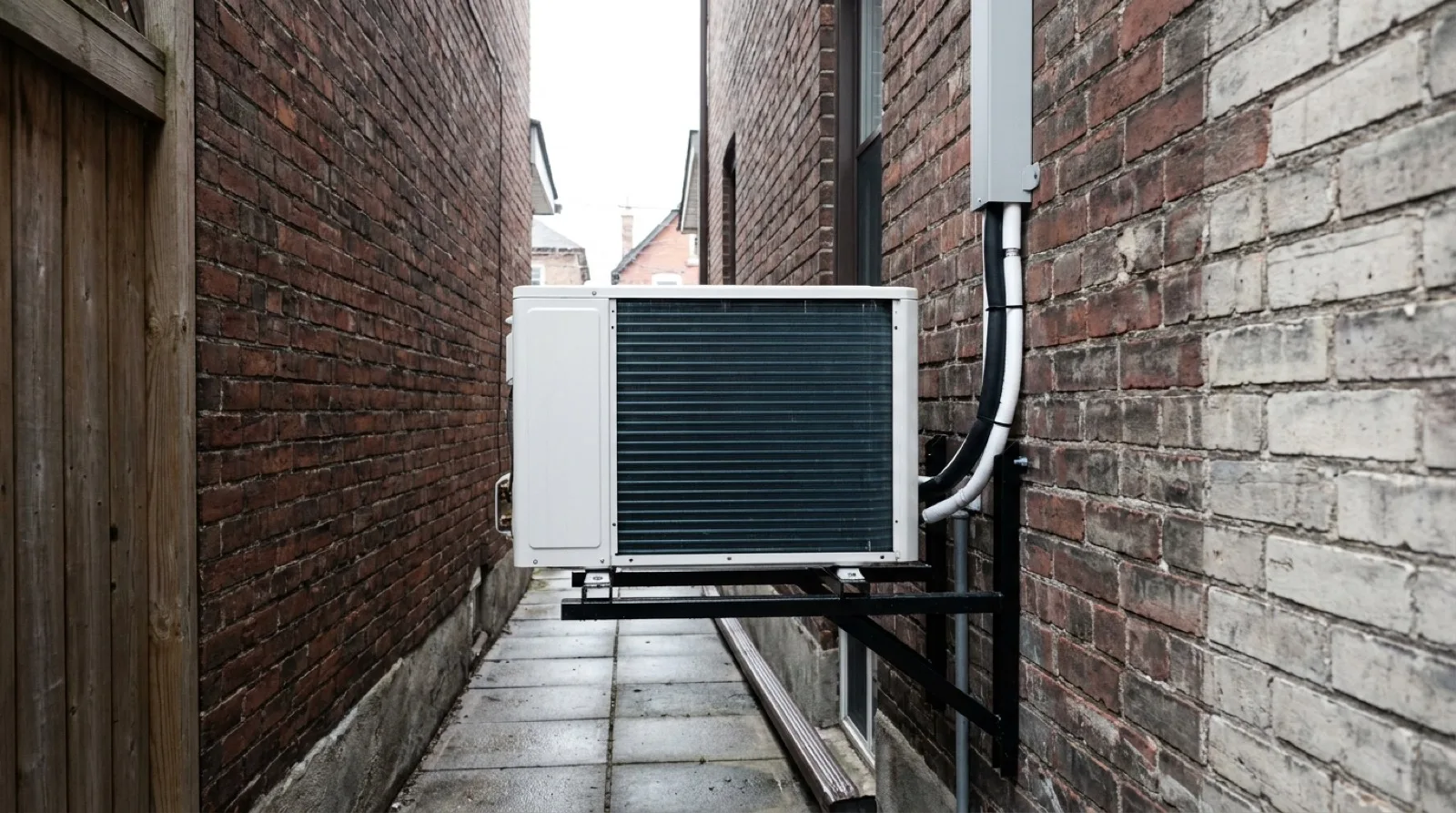
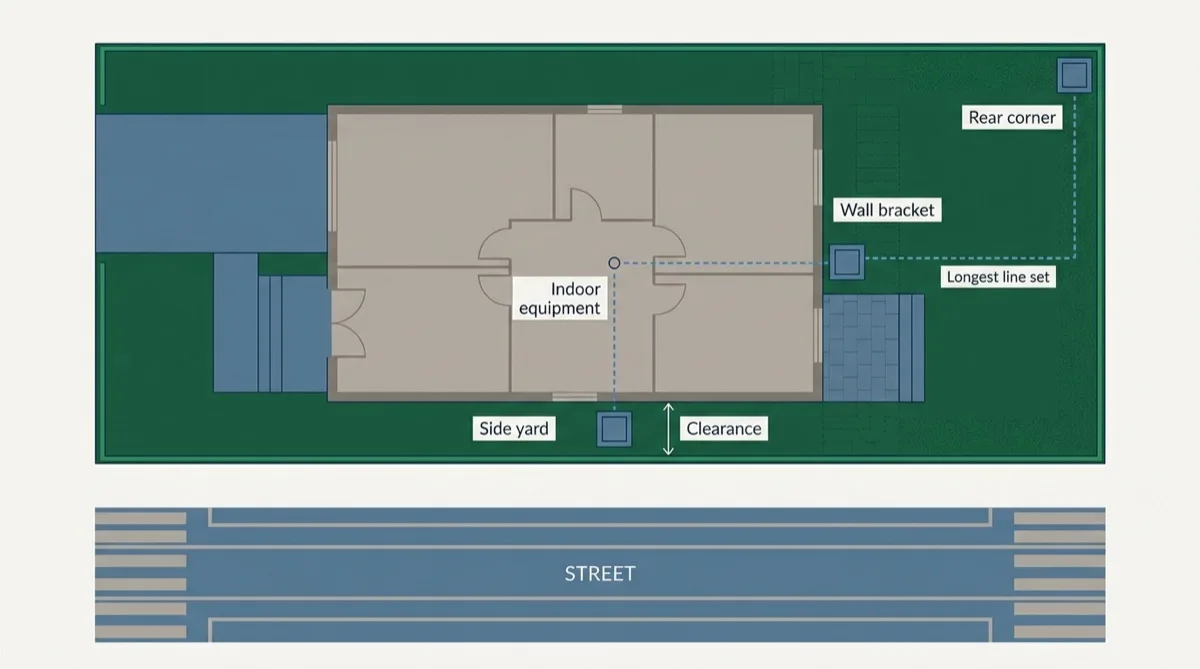
The outdoor unit goes wherever the lot gives it clear air, a short refrigerant run to the indoor equipment, and space for a technician to stand. On narrow Toronto lots that usually means a side yard, a rear corner, or a wall bracket. Distance and access are the parts of that decision you pay for.
What the outdoor unit needs from the site
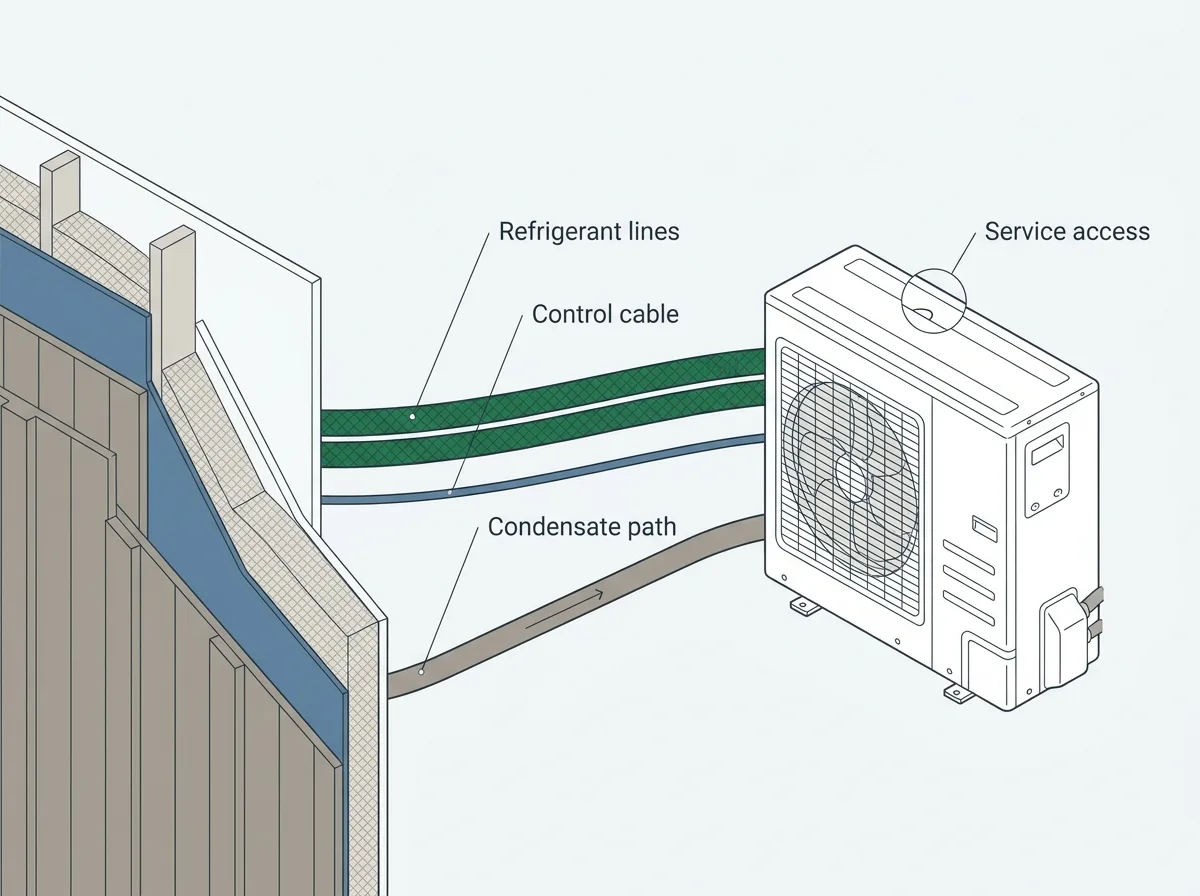
A heat pump diagram is mostly two boxes and a line between them. The outdoor box holds the compressor and the coil that trades heat with outside air. The indoor side is either an air handler or a coil tied into existing ductwork, or one or more wall heads in a ductless system. Running between them are the refrigerant lines, a control cable and a condensate path. Almost every placement charge on a quote traces back to that line and to how hard the box at the end of it is to reach.
The outdoor box needs open air across its intake and discharge faces, because the whole machine works by pushing a large volume of outside air over a coil. It needs somewhere for water to go, since a unit running in winter sheds meltwater each time it comes out of a defrost cycle. It needs to stay reachable, because every diagnostic visit and every repair for as long as you own the system happens at that box. And it needs a route back indoors that is short enough not to add cost and discreet enough that you can live with it.
None of those four requirements is exotic. What is specific to this market is how little room a typical lot leaves for satisfying all four at once, and how directly the compromise shows up in the price.
The lots in this index are mostly city lots
The index holds 618 companies mapped onto 59 defined areas, 51 of which hold at least one company. Of the 59, 41 are classed as neighbourhoods, 11 as cities and 7 as districts. That ratio is the practical fact sitting underneath this whole page. Most of the coverage here describes work inside Toronto's neighbourhood grid rather than in the wider suburban municipalities, and neighbourhood lots are narrow, deep and hemmed in on both sides.
The company counts follow the same pattern in both directions. Willowdale carries 59 companies and Islington-City Centre carries 57, which are the two largest areas in the index. Oakville carries 45, Oshawa 40, Pickering 32 and Richmond Hill 27. A contractor working an Oakville lot and a contractor working a Willowdale lot are quoting the same equipment against very different amounts of side yard, and the difference lands in the line set, the mounting and the access.
Categories split the same way. Of the 618 companies, 221 appear under heat pump installation and 250 under ductless mini splits. Ductless is the larger of the two, which is what you would expect in a market with a lot of older housing, converted attics, additions and homes that never had ducts to begin with. Ductless placement is also the case where the distance between the outdoor unit and the indoor heads is a design choice rather than a fixed constraint.
Distance is priced by the foot
The refrigerant line set is the item that turns a placement preference into money. Ontario HVAC Quotes prices extra refrigerant line at $50 to $100 per foot, which means a decision to put the unit at the back of a long lot rather than beside the house is a quantifiable choice before any equipment is upgraded. Furnace King prices extended line sets beyond 25 feet at $200 to $500 as a separate add on to a heat pump installation.
Base line and wiring are already in the quote. Megacity HVAC itemises refrigerant lines and wiring at $300 to $700 on a three ton heat pump install, and prices the line set at $200 to $500 on an air conditioning project. Those are the figures for a normal run. The per foot rate is what applies once the run stops being normal, and on a deep lot with the unit tucked at the far corner, or on a ductless system with heads at opposite ends of the house, it stops being normal quickly.
There is a second cost hiding in the same decision. Ontario HVAC Quotes notes that attic and soffit runs add labour on top of the line itself, because getting the line from one end of the house to the other without it being visible is slower than running it along an exterior wall. A quote that looks cheap on the line set may have assumed a route you would not accept once you see it.
Ground, pad or bracket
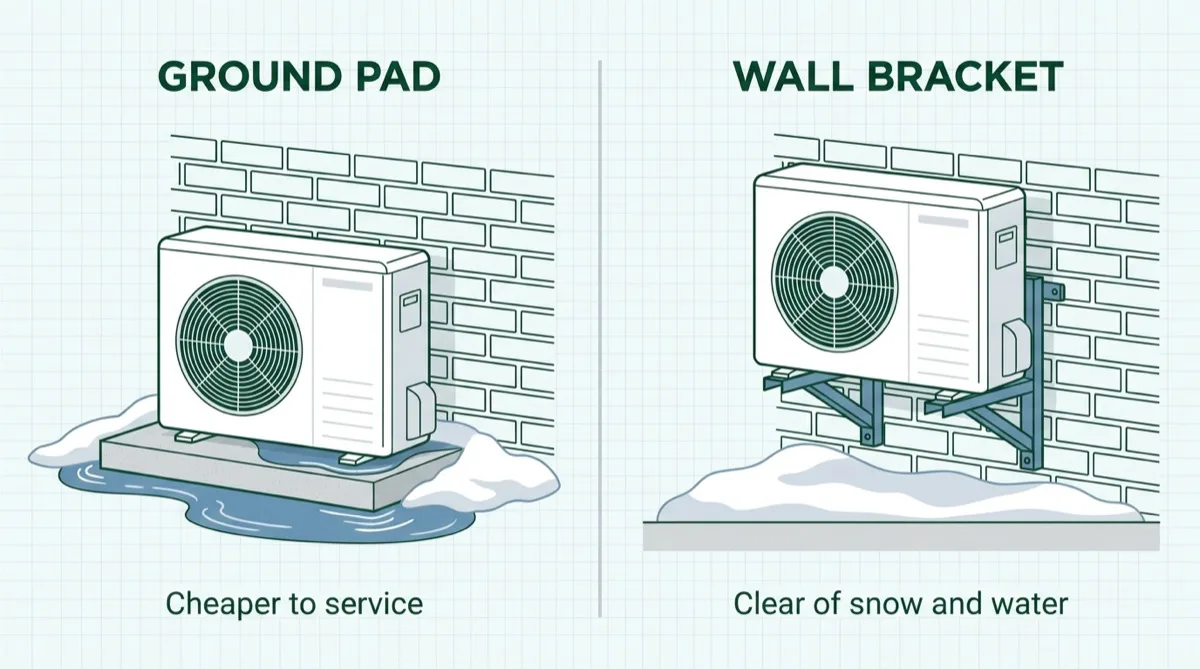
Two mounting numbers appear in the source guides, and they are not describing the same job. Ontario HVAC Quotes prices a concrete pad or a raised bracket at $200 to $800 as part of a ductless mini split project. Megacity HVAC prices a pad or wall bracket at $50 to $200 on an air conditioning install. The gap between those ranges is the gap between setting a unit down on a level pad and hanging it off a structure.
Raising the unit off the ground is not decoration on a Toronto lot. A unit sitting low in a side yard is in the path of roof runoff, snow shed from the eaves and whatever the neighbours' downspout does in a thaw. Raising the unit on brackets takes it out of standing water and out of drifted snow, which matters on a machine that has to move air through its coil in February. It also frees the ground underneath, which on a side yard measured in feet rather than metres is sometimes the only reason the placement works at all.
The trade is service access. A bracketed unit is harder to work on than one at ground level, and every future diagnostic visit inherits that decision. This is worth raising while the design is still on paper rather than after the first repair call.
When the unit cannot be walked in
Furnace King prices crane rental at $500 to $1,000 where the unit cannot be walked into position. That line exists for a specific and common situation: a rear yard reachable only through the house or a neighbour's property, a roof mounted install, or a site where the only path is too narrow for two people, a dolly and a piece of equipment weighing what an outdoor unit weighs.
The reason it belongs in a placement discussion rather than a logistics footnote is that it is avoidable at design time and not avoidable afterwards. Moving the proposed location from the back corner to the side yard can remove the crane entirely, at the cost of a longer or shorter line set and a different view from the kitchen window. Ask which of the two costs a given layout is buying, because a quote rarely spells out that the crane is a consequence of where you asked the unit to go.
Condos and shared walls
Condo work carries an approval step no freehold house has. Exterior unit placement and balcony or wall penetrations need the corporation's sign off, and confirming what the building permits should happen before quotes are compared rather than after one is accepted. A design the corporation rejects stalls the project instead of saving money.
The index reflects that this is a distinct kind of work. Home Trade Standards is recorded under the name Condo HVAC Specialists in Willowdale, Agincourt and Midtown Toronto, listed under heat pump repair. Hudson Condominium Solutions Inc is recorded in Queen West, also under heat pump repair. Climax Heating & Air Conditioning appears in Bayview Village and in Richmond Hill with Condo HVAC Service in the business name. Those records show companies presenting themselves as condo focused. They do not tell you which of them installs, since the categories on each record are the categories the index assigned, and repair and installation are separate categories here.
Density shows up in the area counts too. Downtown areas in this index carry small numbers of companies compared with Willowdale at 59 or Islington-City Centre at 57. A downtown placement question is usually a balcony or a wall, and the pool of companies recorded in those areas is thinner than the pool recorded in the suburbs.
What placement drags along with it
Placement does not stop at the pad. Ontario HVAC Quotes prices a dedicated circuit and disconnect at $300 to $800, and the length and route of that circuit follow the unit's location as surely as the refrigerant line does. Where the panel cannot carry the load at all, Ontario HVAC Quotes prices an upgrade at $1,500 to $3,000, and Imperial Heating prices the same upgrade at $1,000 to $3,000 on a heat pump installation.
Permits sit in the same bracket. Megacity HVAC prices permits and ESA electrical inspection at $200 to $400 on a heat pump project, and Ontario HVAC Quotes prices permits and inspection at $100 to $400 on a ductless project. A quote that shows no permit line has left that work out. Full pricing for both routes sits on the heat pump installation cost and ductless mini split cost pages.
Where the outdoor unit goes on a Toronto lot: frequently asked questions
How far can the outdoor unit be from the indoor equipment?
- Far enough to matter financially. Ontario HVAC Quotes prices extra refrigerant line at $50 to $100 per foot, and Furnace King prices extended line sets beyond 25 feet at $200 to $500. Neither source names a maximum length. The limit on any given job comes from the equipment manufacturer, so ask the contractor to state it in writing.
Does the outdoor unit have to sit on the ground?
- No. Ontario HVAC Quotes prices a concrete pad or a raised bracket in the same line item at $200 to $800, and Megacity HVAC prices a pad or wall bracket at $50 to $200 on an air conditioning project. Wall and roof mounting exists precisely because narrow lots and flood prone side yards make ground placement awkward.
What does crane access cost?
- Furnace King prices crane rental at $500 to $1,000 where the unit cannot be walked into position. That figure applies to sites with no clear path for two people and a dolly, such as an enclosed rear yard behind a semi or a roof mounted installation. Ask whether crane time is inside the quoted price or billed separately.
Does a condo change where the unit can go?
- Yes. Exterior unit placement and balcony or wall penetrations need the corporation's approval before any work starts, which is a rule a freehold house does not face. Confirm what the building permits before comparing quotes, because a design the corporation rejects stalls the project instead of saving money.
Which placement costs show up as separate lines on a quote?
- Ontario HVAC Quotes itemises extra line at $50 to $100 per foot, a pad or raised bracket at $200 to $800, and a dedicated circuit and disconnect at $300 to $800. Furnace King adds crane rental at $500 to $1,000 and extended line sets at $200 to $500. Megacity HVAC prices permits and ESA inspection at $200 to $400.
Where these figures come from
Extra refrigerant line $50 to $100 per foot, concrete pad or raised bracket $200 to $800, dedicated circuit and disconnect $300 to $800, panel upgrade $1,500 to $3,000, permits and inspection $100 to $400 on a ductless project
Extended line sets beyond 25 feet $200 to $500, crane rental $500 to $1,000 where the unit cannot be walked into position
Pad or wall bracket $50 to $200, line set $200 to $500 on an air conditioning project
Refrigerant lines and wiring $300 to $700 on a 3 ton heat pump install, permits and ESA electrical inspection $200 to $400
618 companies across 59 defined areas, 51 of which hold at least one company. Willowdale carries 59 companies and Islington-City Centre 57; 221 companies carry heat pump installation and 250 carry ductless mini splits