How to read heat pump company reviews in Ontario when most companies score 4.8 or higher

Read the review count before the star rating. Across the 607 rated companies in this index the mean rating is 4.82 and 492 sit at 4.8 or higher, so stars barely separate anyone. Review counts run from a single review to 29,834, and the one-star reviews are where to look for specific complaints.
What counts as a good rating for a heat pump company in Ontario?
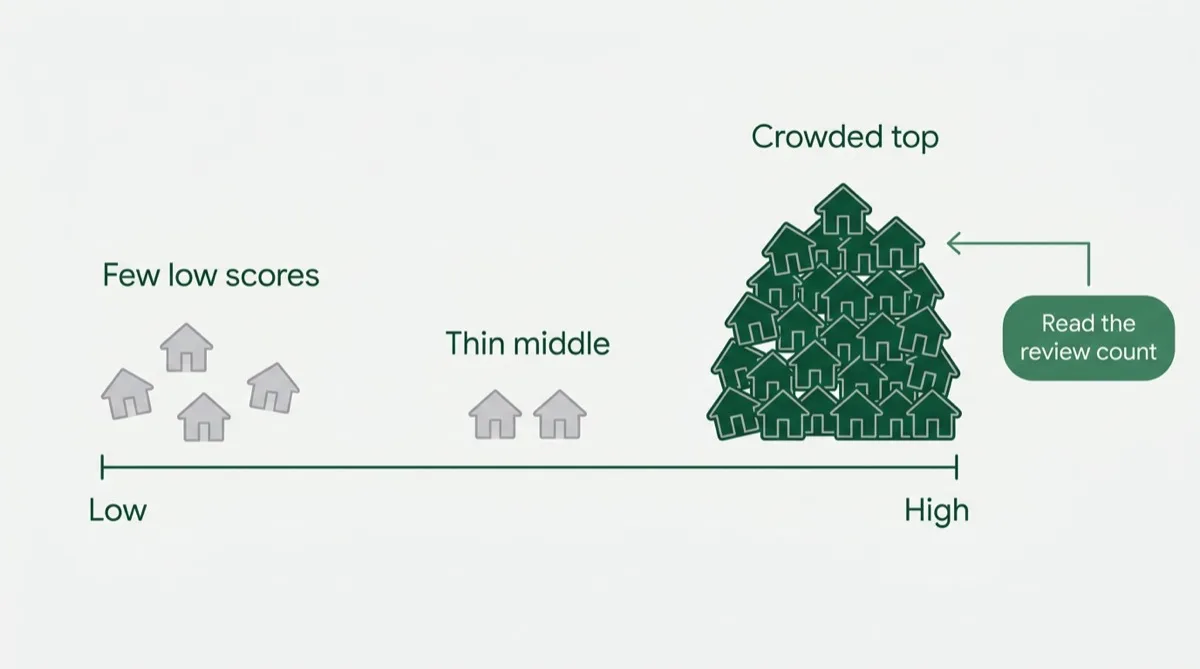
A good rating is one read against the rest of the field, and the field sits high. Across the 607 rated companies in this index the mean Google rating is 4.82 and the median is 4.9. Of those 607, 492 are rated 4.8 or higher: 263 at exactly 5.0, 141 at 4.9 and 88 at 4.8. Widen the band to 4.5 and 569 of the 607 are inside it. Only 14 fall below 4.0.
That changes what a number on a listing means. A 4.6 looks solid on its own and sits below the median of this field. A 4.9 is the median, an ordinary position. Using 4.5 as a cut-off removes 38 of the 607 rated companies and keeps the other 569, so it filters very little.
The bottom of the scale is where the rating does separate something. Of the 14 companies below 4.0, three sit at 1.0 on a single review each, so they describe one customer. The other 11 carry between two and 169 reviews, and a low score with a few dozen reviews behind it is rare enough in this dataset to justify reading what those reviewers wrote.
Area averages are just as compressed. Among the 12 areas with at least 20 rated companies, the averages run from 4.67 in Pickering to 4.91 in Richmond Hill, and Willowdale averages 4.89 across its 57 rated companies. Nothing in those figures supports picking one area's contractors over another's, so compare the companies, not the postal code.
Why a perfect 5.0 usually means a short history
A 5.0 is common enough here that it carries little weight on its own. The 263 companies at exactly 5.0 hold a median of 34 reviews, against 93 for the 344 rated below 5.0, so the perfect-score group is the less reviewed group. Of the 263, 52 rest on fewer than 10 reviews and 85 on fewer than 20.
Small numbers explain it. Among four reviews, a single one-star review turns a 5.0 into a 4.0. On a company with 600 reviews, one new one-star review moves the average by less than a hundredth of a star. A 5.0 on eight reviews means the rating has no settled opinion yet. That is not evidence against the company, since every new business starts at zero, but it moves the decision onto the site visit and the written quote.
The perfect group is not all thin. Of the 263, 54 carry 100 reviews or more, and a sorted list shows them exactly as it shows the eight-review companies. The shown score is also rounded to one decimal. In this index, 69 of the companies shown at 5.0 hold at least one review below five stars, and their true averages run from 4.95 to just under 5.
How do you read heat pump company reviews in Ontario?
Read the star breakdown before the average, and read the one-star reviews first. Each record in this index carries a count of reviews at each star level. Summed across the 284,472 reviews behind the 607 rated companies, 92.6% are five-star, 3.4% are four-star and 3.3% are one-star. Two-star and three-star reviews together make up 0.7%, just 2,015 reviews.
So unhappy customers here rarely leave a middling score. They go straight to the bottom. At 334 of the 607 rated companies, one-star reviews outnumber two-star and three-star reviews combined, and 353 of the 618 records hold at least one one-star review. That pile is where the specific complaints are.
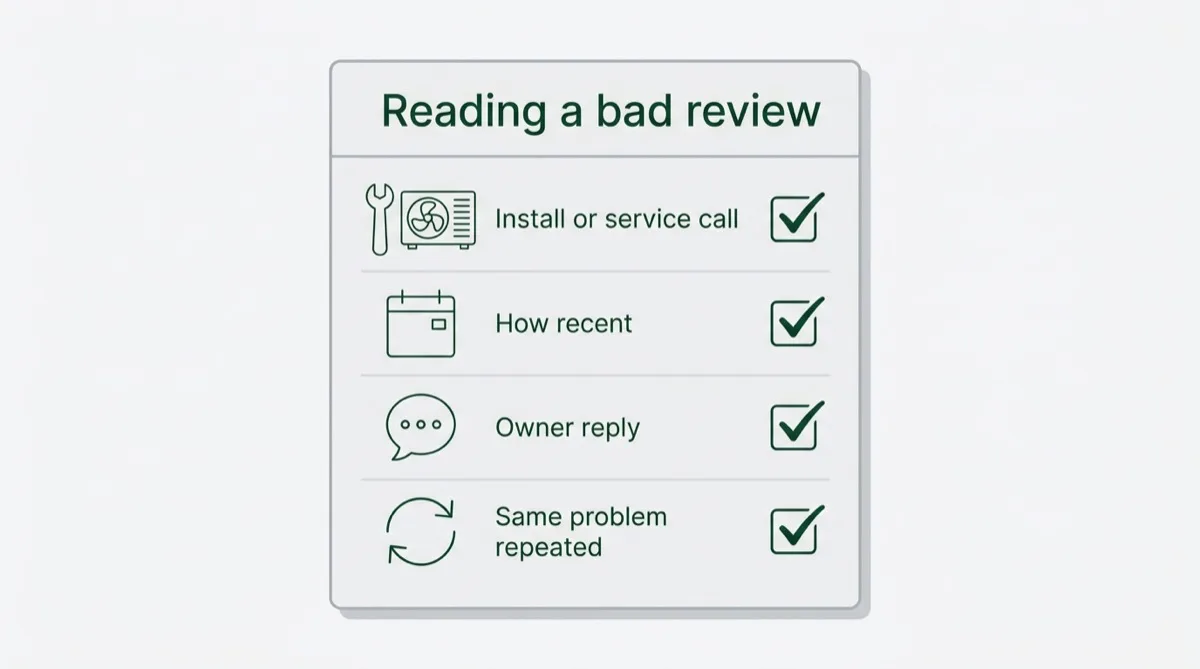
A few one-stars are normal for a busy company. Among the 218 companies with 100 or more reviews, the median one-star share is 1.8%, and only two reach 10%. What the complaints say matters more than how many there are, and four checks sort them quickly.
First, was it an installation or a service call? The two are different jobs, so weigh the complaints that match the work you need, whether that is heat pump repair or a new system. Second, how recent is it? Third, did the owner reply, and does the reply deal with the problem or argue with the customer? Fourth, does the same problem come up again and again: missed appointments, a unit that never heated properly, a warranty call nobody returned? One angry review is one job. The same complaint five times is a pattern.
What review volume tells you, and what can distort it
Review counts are the column with real spread. The 607 rated companies hold 284,472 reviews between them, with a median of 62 and a maximum of 29,834 on one record. Only 35 carry 1,000 or more, and the ten largest hold 148,501, which by this site's arithmetic is 52.2% of every review in the index.
Volume reflects how many jobs a company handles, how long it has traded and how often it asks customers to post, and none of that is workmanship. What volume does give you is confidence in the average. A 4.7 on 700 reviews is a measurement. A 5.0 on three is closer to an anecdote.
The rating also covers the whole business, not only its heat pump work. By Google Maps business type, 444 of the 618 records are listed as an HVAC contractor and 43 as a plumber, so a high score can rest mostly on furnace, air conditioning or plumbing calls. Reviews that mention a heat pump by name tell you more than the headline number.
Some reviews are not what they seem. Google's Maps content policy says reviews or ratings that have been paid for, directly or in kind, are not allowed and will be removed, and it bars businesses from offering incentives such as payment, discounts or free services in exchange for a review. The same policy treats unusual volumes or patterns of review contributions as a sign of rating manipulation, so a cluster of short, similar five-star reviews is worth noticing. Nothing on a listing proves where a review came from.
Canadian law covers this too. The Competition Bureau's Deceptive Marketing Practices Digest describes companies asking employees to post positive reviews or offering customers incentives to leave them. It treats that under the Competition Act's ban on claims that are false or misleading in a material respect.
How this site weighs a rating against its review count
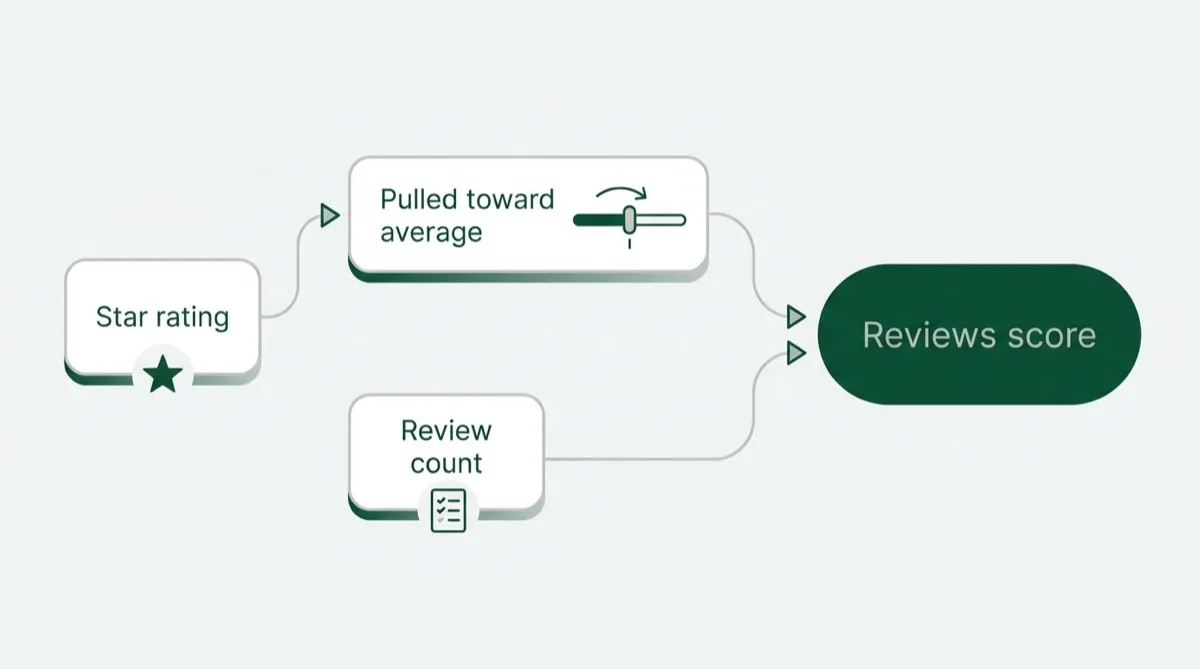
Every list on this site is sorted by one published score out of 100, and 45 of those points come from Google reviews, as the methodology page sets out. Up to 30 come from the star rating, adjusted as if every company already had 10 reviews at the dataset average of 4.82, with ratings scored from 3.5 upward. Up to 15 come from review volume, on a curve that is full at 200 reviews.
The blend is what stops a thin perfect score from winning. Worked through that formula, a 5.0 on three reviews becomes an adjusted 4.86 and earns about 31 of the 45 review points, while a 4.8 on 300 reviews stays at 4.80 and earns about 41. A 1.0 from a single review adjusts to about 4.47, because with one vote a company sits close to the average whatever its stars say.
Companies with fewer than three reviews or a rating below 4.0 keep their profile and still appear in their area and category lists. The site never names them as an area's leading pick or places them in the front page's ranked eight.
The other 55 points come from what a company states on its own website and from its record, which the guide to checking a heat pump contractor explains. The heat pump installation listings are sorted by that score. No company can buy a better position. The same score decides which listed company receives a job a homeowner sends through the site's quote form, and the about page says the directory earns nothing today.
What reviews cannot tell you about a heat pump job
Reviews describe what a customer could see on the day: whether the crew turned up on time, whether the invoice matched the quote, whether the basement was left clean. Those are real observations, and they are observations about one visit.
Much of what decides a heat pump's value shows up months later. As the guide to sizing a heat pump explains, a unit sized only for the cooling load will short cycle, switching on and off too often, and lean on backup heat in January, and a reviewer writing in June cannot see that. Neither the star rating nor the review count says anything about warranty terms, permits or whether anyone calculated the house's heat loss.
Use reviews to build a shortlist of three, then compare those companies on paper by asking each for the same scope in writing, as set out in what belongs in a heat pump quote. If you need service rather than an install, the reviews that mention winter call-outs are the ones to read, and booking heat pump repair in a cold snap covers that case.
How to read heat pump company reviews in Ontario: frequently asked questions
Is a 4.5 rating good for a heat pump company in Ontario?
- It sits in the lowest tenth of this index. Across the 607 rated companies here the median rating is 4.9, and only 49 of the 607 are rated 4.5 or lower. Check the review count and the one-star complaints before ruling a company out on that number alone.
Should I trust a 5.0 rating with only a few reviews?
- Treat it as no settled opinion rather than a strong signal. Of the 263 companies at exactly 5.0 in this index, 52 have fewer than 10 reviews, and with four reviews a single one-star turns a 5.0 into a 4.0. A new company is not a bad one, so let the written quote do the deciding.
Why do heat pump company reviews have so few three-star ratings?
- Unhappy customers here mostly give one star instead. Of the 284,472 reviews behind the 607 rated companies, 3.3% are one-star while two-star and three-star reviews together come to 0.7%. That makes the one-star reviews the most useful place to find specific complaints.
Can a company pay for Google reviews?
- Google's policy does not allow it. Its Maps content policy says paid reviews, and reviews posted in exchange for incentives such as discounts, are not allowed and will be removed. Canada's Competition Bureau also discusses fake reviews under the Competition Act's misleading advertising provisions.
Does HeatPumpIndex rank companies by star rating alone?
- No, rating and review count are scored together. The rating is adjusted as if each company already had 10 reviews at the 4.82 average, and review volume earns its own points, full at 200 reviews. Together they make up 45 of the 100 points in the published score.
Where these figures come from
Google's Maps content policy says reviews or ratings that have been paid for, directly or in kind, are not allowed and will be removed, bars businesses from offering incentives such as payment, discounts or free services for a review, and lists unusual volumes or patterns of review contributions as rating manipulation.
The Competition Bureau describes companies encouraging employees to post positive reviews or giving customers incentives to leave them, and notes that the Competition Act's misleading advertising provisions prohibit representations that are false or misleading in a material respect.