How often should a heat pump be serviced in Toronto?
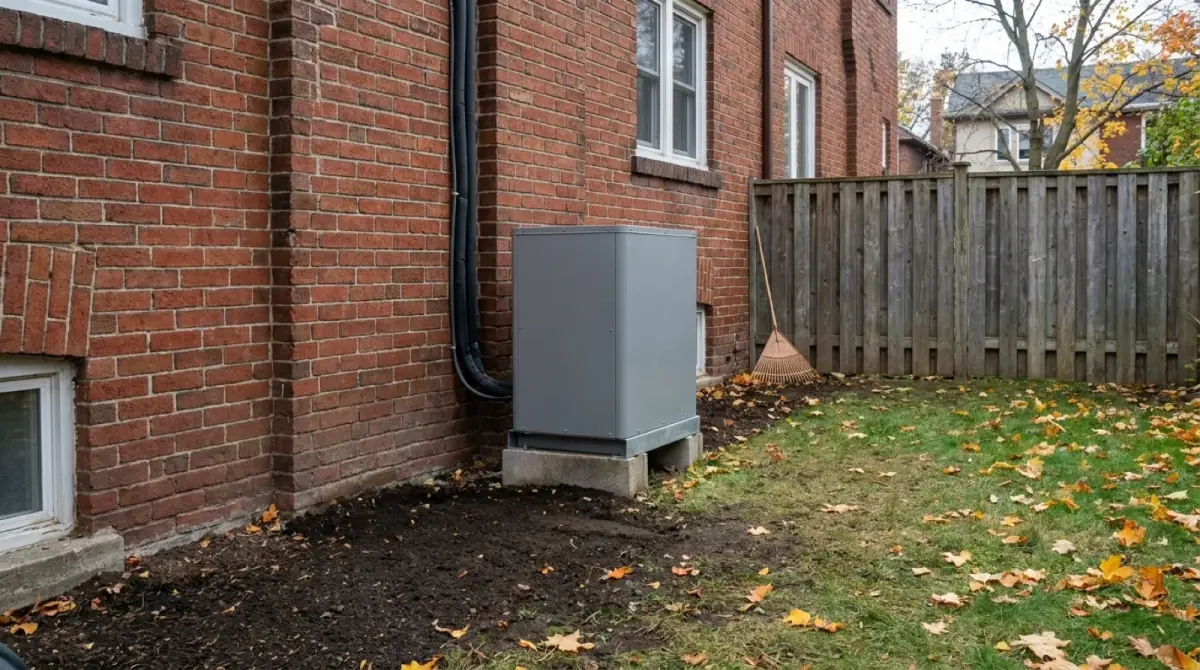
Once a year. Natural Resources Canada's heat pump guide says a qualified contractor should do annual maintenance, and that the homeowner should change or clean the air filter every 3 months in between. EcoFrost Heating, a GTA contractor, prices its own annual heat pump tune-up at $149 to $179 and suggests booking it in spring or fall.
How often should a heat pump be serviced in Toronto?
Once a year by a professional, with small jobs done by the homeowner in between. Natural Resources Canada's guide to heating and cooling with a heat pump says to have a qualified contractor do annual maintenance to make sure everything is in good working order. It gives the same once-a-year advice for ground source systems, the kind that draw heat from pipes buried in the ground. That federal page is the plainest statement of the interval, and it is the one this guide works to.
A heat pump has no off season, which is why the visit matters. EcoFrost Heating's maintenance guide for GTA homeowners says a heat pump logs roughly twice the running hours of a furnace or an air conditioner alone, because it heats in winter and cools in summer. That is a contractor's estimate, not a measured Toronto figure, but the point holds: the compressor, the fan motor and the electrical parts work through both halves of the year.
Not every published schedule matches. New Brunswick's energy efficiency program, writing about ductless units (wall-mounted indoor heads with no ductwork), suggests a contractor visit every 12 to 18 months. The federal guidance says once a year, and a Toronto owner has no reason to stretch it. If the system is new, what a heat pump install involves covers the work that comes before the first service visit.
To find someone to do the visit, 159 of the 618 records in this index carry the heat pump repair category, which is where service and repair companies are listed. HeatPumpIndex is a free directory that sells and installs nothing, and no company can buy a better position on it.
What a tune-up covers, and how it differs from a fault call
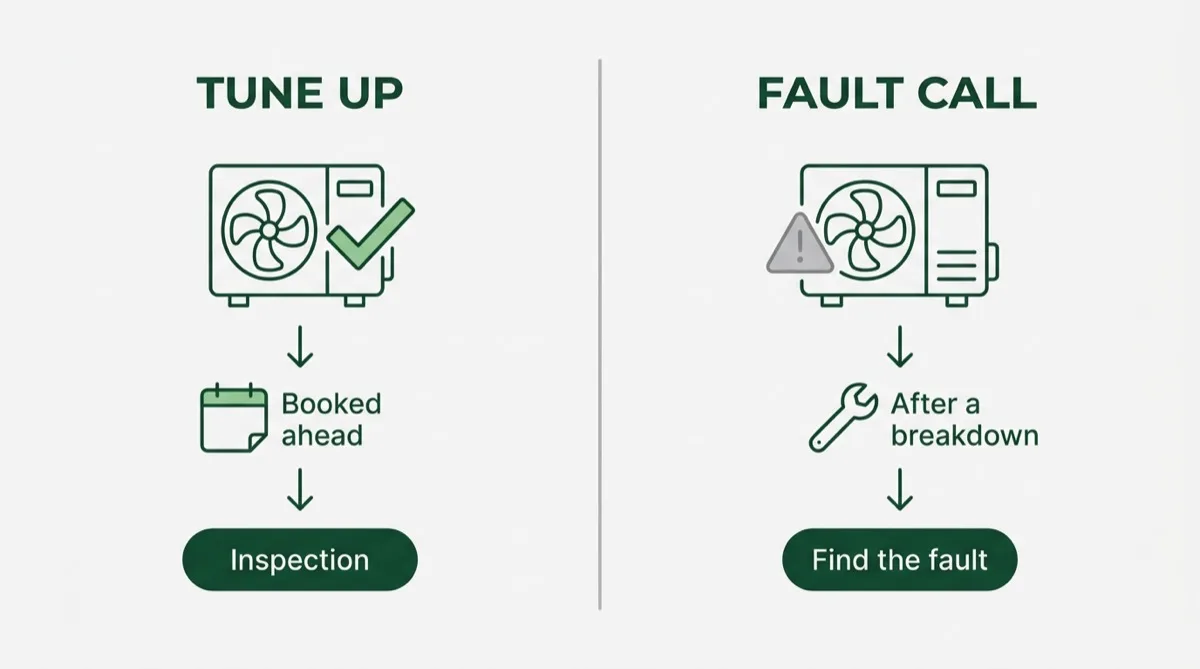
A tune-up is booked while nothing is wrong. EcoFrost Heating prices its own annual heat pump tune-up at $149 to $179 and describes it as a full inspection and performance test; that is one company's flat rate, not a survey of what GTA firms charge. Its maintenance guide lists what the visit includes. The technician measures the refrigerant charge (the amount of refrigerant in the sealed circuit) and checks and tightens electrical connections. They test the capacitor and contactor, the small parts that start the motors and switch them on, and clean the indoor and outdoor coils. They also test the defrost board and sensor, which melt frost off the outdoor coil in winter, check the thermostat, and run the system in both heating and cooling mode.
A fault call is a different purchase. It is booked because something has stopped working, and the fee pays for finding the failed part. Imperial Heating says most HVAC companies in Toronto charge $80 to $150 for a diagnostic visit. That is its read of the trade in general, not a heat pump fee, and Imperial waives its own fee when the repair goes ahead. GTA HVAC Pros lists a diagnostic or service call at $100 to $200 and advises asking before you book whether the fee is separate or credited toward the repair.
The two visits meet when a tune-up turns up a worn part and the technician quotes a repair. The published repair figures for this market are collected on the heat pump repair cost page. A no-heat call in the middle of a cold spell is a separate problem, covered in booking heat pump repair during a cold snap.
When in the year to book the visit
EcoFrost Heating's maintenance guide says to book the professional visit in spring, before the cooling season, or in fall, before the heating season. Either slot does the job as long as the visit happens every year.
Fall has a case of its own in Toronto. The same guide calls the switch to heating mode the start of the hardest working period for a heat pump here. Its fall checklist includes confirming that the defrost cycle runs and returns the unit to heating. A fall visit checks that before the outdoor coil starts to frost over.
Spring suits a house where the heat pump came through winter with something the owner noticed and lived with, such as a new noise or weak airflow from the vents. EcoFrost's guide notes that in spring the system has just come off heating mode and is ready for inspection.
The slots to avoid are the busy ones. GTA HVAC Pros notes that evening, weekend and heat wave calls can cost more, and a routine visit has no reason to land in one of them. Booking early in the season, before the first hot or cold stretch, keeps the tune-up a scheduled job rather than a rushed one. Before anyone arrives, checking a heat pump contractor in Ontario covers what to ask.
What the homeowner does between visits
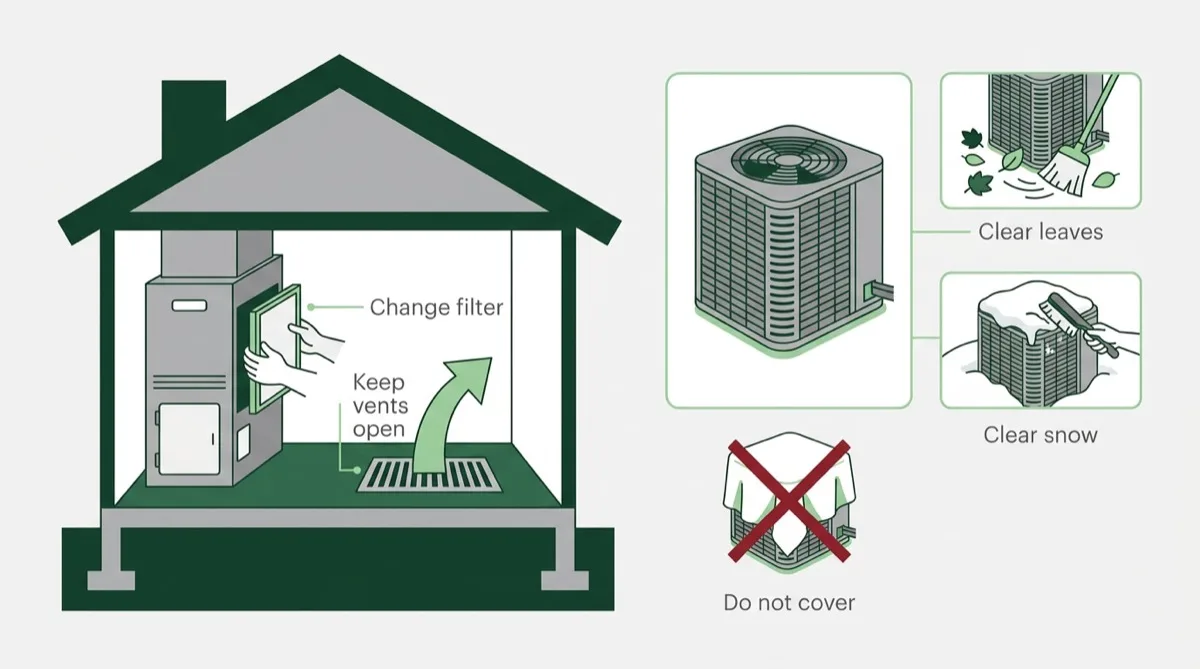
Most of the upkeep between tune-ups is about keeping air moving. Natural Resources Canada says to change or clean the air filter every 3 months, because a clogged filter cuts airflow and efficiency, and to keep vents and air registers clear of furniture and carpeting. EcoFrost Heating's guide is stricter for thin filters: it says to replace thin 1-inch filters monthly and thicker 4-inch media filters, the deep pleated kind, every 3 to 6 months. Check which kind the system takes before settling on a schedule.
The outdoor unit needs a clear path for air in every season. In fall, rake leaves and yard debris away from it. In winter, look at it after each snowfall. New Brunswick's energy efficiency program explains why: snow built up around the outdoor unit starves it of air, which often leads to the unit freezing up or to a fan motor failure. Its advice is to clear that snow each time you shovel the driveway.
There are two things not to do. EcoFrost Heating says never to cover the outdoor unit in winter, because it is heating the house and needs constant airflow, and not to attack ice with sharp tools but to let the defrost cycle clear it. Its guide treats light frost on the coil as normal and heavy ice that stays after a defrost cycle as a reason to call a technician. Where the unit sits on the lot changes how much of this work it creates, which where the outdoor unit goes on a Toronto lot covers.
Keeping a service record
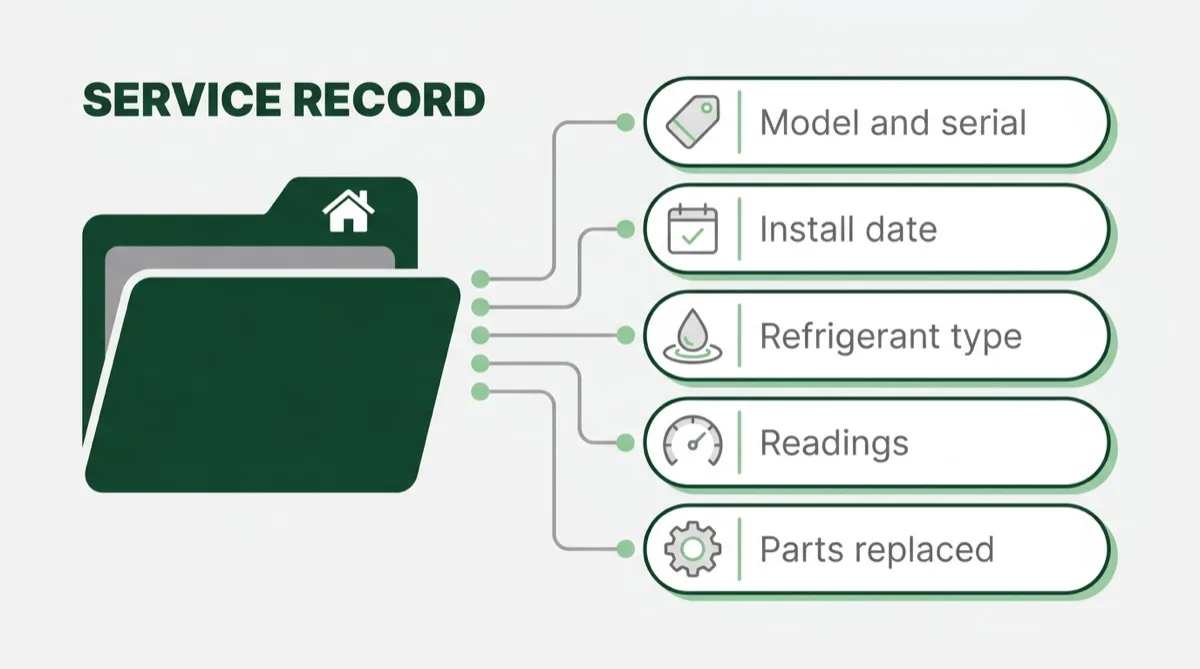
Each visit should leave a document behind, and the homeowner is the one who keeps it. A useful file starts with the model and serial numbers of the indoor and outdoor units, the install date, the installer and the refrigerant type. For each visit it adds the date, what was checked, the readings taken and any parts replaced. Readings from a system that is working become the baseline a later technician compares against.
The file matters most when a part fails. Natural Resources Canada puts the service life of an air source heat pump at between 15 and 20 years and calls the compressor the critical component. It says most heat pumps carry a one-year warranty on parts and labour, plus an additional five- to ten-year warranty on the compressor for parts only. It adds that warranties vary between manufacturers, so the fine print is worth reading.
GTA HVAC Pros adds that a manufacturer parts warranty may cover the component while leaving labour, refrigerant, shipping or diagnostic time to the homeowner. It suggests having the contractor check the model and serial number before assuming coverage applies. Two of the firms quoted in this guide, Imperial Heating and GTA HVAC Pros, are contractors listed in this index, and EcoFrost Heating is a GTA contractor, so their figures are what sellers publish. Read your own warranty for any condition it attaches to servicing, and keep the invoices that would show you met it.
This index cannot hold that history for you. Its records carry business details, categories, ratings and contact information, with no field for job history, maintenance plans or warranty terms. The company that services a unit in five years may not be the one that installed it, and the invoices are how the history moves between them. When a repair quote gets large enough that replacement comes up, repair or replace an aging heat pump works through that decision.
How often a heat pump should be serviced in Toronto: frequently asked questions
How often should a heat pump be serviced?
- Once a year, by a qualified contractor. That is the interval in Natural Resources Canada's heat pump guide, which also asks the homeowner to change or clean the filter every 3 months.
What does an annual heat pump tune-up cost in Toronto?
- EcoFrost Heating charges $149 to $179 for its own visit. That is one GTA company's flat rate for a full inspection and performance test, so quotes from other firms will differ.
Is a tune-up the same as a diagnostic visit?
- No, a diagnostic visit is a fault call. It is booked after something breaks; Imperial Heating puts the usual Toronto fee at $80 to $150, and GTA HVAC Pros lists $100 to $200.
Should I cover my outdoor unit in winter?
- No, it needs airflow while it heats the house. EcoFrost Heating's guide says not to cover it. Clearing snow from around it after each snowfall does the protecting instead.
Does this directory show which companies offer maintenance plans?
- No, the records have no maintenance plan field. They show the 159 records that list heat pump repair and how to reach them, so plan details have to be asked for directly.
Where these figures come from
Natural Resources Canada says a qualified contractor should do annual maintenance on a heat pump, the homeowner should change or clean the air filter every 3 months, air source heat pumps have a service life of between 15 and 20 years, and most heat pumps carry a one-year parts and labour warranty plus a five- to ten-year compressor warranty for parts only.
EcoFrost Heating's maintenance guide says a heat pump logs roughly twice the running hours of a furnace or an air conditioner alone, that the professional visit belongs in spring or fall, that 1-inch filters should be replaced monthly and 4-inch media filters every 3 to 6 months, and that the outdoor unit should never be covered in winter.
New Brunswick's energy efficiency program suggests a contractor visit every 12 to 18 months for ductless units and says snow built up around the outdoor unit starves it of air.
EcoFrost Heating prices its own annual heat pump tune-up and performance test at $149 to $179.
Imperial Heating says most HVAC companies in Toronto charge $80 to $150 for a diagnostic visit, and waives its own fee when the repair proceeds.
GTA HVAC Pros lists a diagnostic or service call at $100 to $200 and notes that evening, weekend and heat wave calls can carry a higher dispatch or labour rate.