HeatPumpIndex

How Much Does a Geothermal Heat Pump Cost in Toronto in 2026?

Last updated: By HeatPumpIndex Evidence Desk

The ground loop, not the heat pump, is what makes geothermal expensive. A horizontal loop needs land that can be excavated; vertical boreholes need drilling access and, in Ontario, a licensed well contractor. Site restoration afterwards belongs in the quote too. The indoor equipment is comparable in price to a good air source system, so the loop is where quotes diverge.
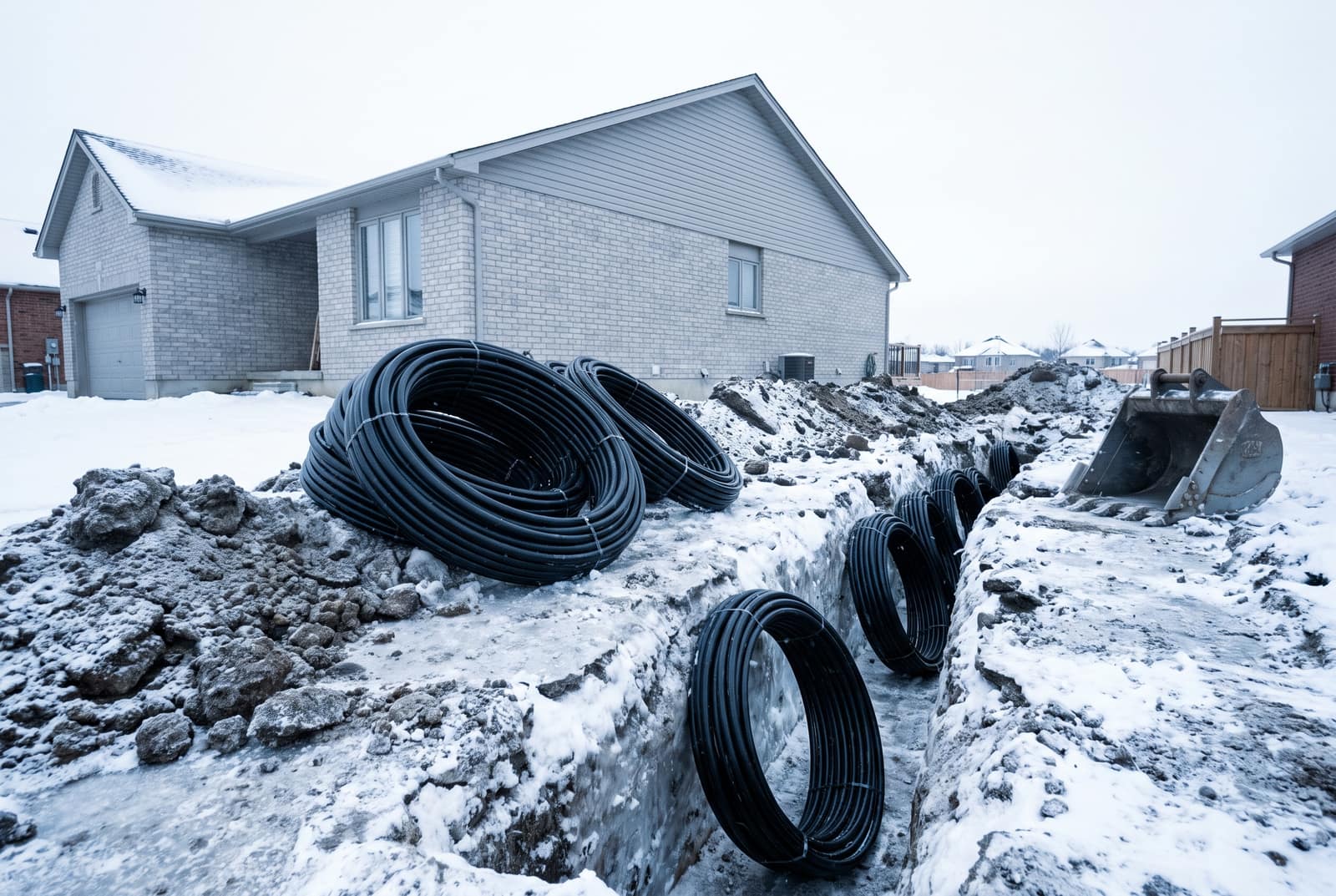
An open trench cut across a frozen back yard behind a pale grey brick bungalow during a geothermal ground loop installation, with large coils of black ground loop pipe stacked along the excavated soil and an excavator bucket resting at the far end.
Generated illustration. No company listed on this page, and no job any of the prices below came from, is pictured.

What does a geothermal system cost, loop field included?

This range rests on 5 independent published sources, across 8 priced lines. Every figure was re-found in the page it is credited to, and each row carries the condition that source attached to it. Where the sources disagree, both numbers are shown and neither range is stretched to cover the gap.

Whole system prices and equipment only prices answer different questions, so they are drawn on separate axes. The distance between the two is the ground loop, which is the part of a geothermal quote that never appears on an equipment list.

per project (CAD)

  • Complete geothermal system, Ontario installation$20,000–$50,000

    Superior Plumbing (Ontario, 2026 guide)

  • Ground source heat pump, installed total$20,000–$40,000

    Furnace King (Ontario, 2026 pricing guide)

  • Horizontal ground loop system (needs open land)$25,000–$40,000

    Superior Plumbing (Ontario, 2026 guide)

  • Vertical ground loop system (deep drilling)$35,000–$55,000

    Superior Plumbing (Ontario, 2026 guide)

equipment only (CAD)

  • Geothermal equipment only (ground source, before installation)$8,000–$15,000

    Furnace King (Ontario, 2026 pricing guide)

  • Indoor geothermal heat pump unit only (Bosch)$4,000–$9,000

    Superior Plumbing (Ontario, 2026 guide)

Priced on a unit no other row on this page shares, so there is nothing to draw them against and they are listed rather than charted:

  • Installation, ground loop and labour $12,000–$25,000 labour and loop (CAD), Furnace King (Ontario, 2026 pricing guide)
  • Operating cost, average home $100–$150 per month (CAD), Superior Plumbing (Ontario, 2026 guide)

Canadian dollars, researched August 2026, each row traced to the supplier or installer that published it. Add 13% HST unless the row says otherwise. Rebates come off after HST.

Canadian dollars, researched August 2026, each row traced to the supplier or installer that published it. Add 13% HST unless the row says otherwise. Rebates come off after HST.
ItemTypical rangeUnitSource
Complete geothermal system, Ontario installationSuperior Plumbing states the price depends on home size, lot type and the loop system needed. For comparison it puts replacing a gas furnace and central air conditioner at roughly $8,000 to $15,000 combined.$20,000–$50,000per project (CAD)Superior Plumbing (Ontario, 2026 guide)
Ground source heat pump, installed totalTotal installed. Furnace King's table states these prices include equipment, standard installation materials and labour, and reflect the GTA market as of early 2026. It flags ground source as a new-build choice.$20,000–$40,000per project (CAD)Furnace King (Ontario, 2026 pricing guide)
Geothermal equipment only (ground source, before installation)The equipment column of Furnace King's system-type table. Installation is priced separately at $12,000 to $25,000 and the total installed at $20,000 to $40,000. NOTE: $8,000-$15,000 also appears in this same document as the total installed cost of a multi-zone ductless system; this row is bound to the ground-source table line.$8,000–$15,000equipment only (CAD)Furnace King (Ontario, 2026 pricing guide)
Installation, ground loop and labourThe installation column of Furnace King's system-type table, covering the ground loop and labour. Equipment is a separate $8,000 to $15,000. Furnace King attributes the high cost to drilling vertical boreholes or trenching horizontal loops.$12,000–$25,000labour and loop (CAD)Furnace King (Ontario, 2026 pricing guide)
Horizontal ground loop system (needs open land)Requires sufficient open land. Superior Plumbing prices the vertical alternative higher, at $35,000 to $55,000, because it needs deep drilling.$25,000–$40,000per project (CAD)Superior Plumbing (Ontario, 2026 guide)
Vertical ground loop system (deep drilling)The deep-drilling option, chosen when there is not enough open land for a horizontal loop, which Superior Plumbing prices at $25,000 to $40,000.$35,000–$55,000per project (CAD)Superior Plumbing (Ontario, 2026 guide)
Indoor geothermal heat pump unit only (Bosch)BOSCH equipment specifically, indoor unit alone. Superior Plumbing puts the complete Bosch installation including ground excavation at $22,000 to $45,000. It is not a price for geothermal indoor units generally.$4,000–$9,000equipment only (CAD)Superior Plumbing (Ontario, 2026 guide)
Operating cost, average homePer month, for an average home, and it is a running cost rather than a price. Superior Plumbing puts it at roughly 30 to 60% less than conventional oil, propane or electric resistance heating, and says actual cost depends on home size, insulation and system sizing.$100–$150per month (CAD)Superior Plumbing (Ontario, 2026 guide)

Horizontal trench or vertical borehole, and what decides which one your lot gets

The ground loop is what makes geothermal expensive, and there are only two ways to put one in. The choice is made by your lot, not by your budget, which is why it is the first question a quote should answer.

Horizontal loop

$25,000–$40,000 per project (CAD), Superior Plumbing (Ontario, 2026 guide)
  • Needs land that can be excavated.
  • Needs significant open land that most Toronto lots do not have, so it is mostly a large lot and rural proposition.
  • Depth to bedrock and soil type decide whether it is possible at all.

Vertical loop

$35,000–$55,000 per project (CAD), Superior Plumbing (Ontario, 2026 guide)
  • Needs drilling access and, in Ontario, a licensed well contractor.
  • Where the land is not there, urban projects get pushed to this one.
  • Site access for a drilling rig on a constrained urban lot is its own constraint.

Both figures above are the whole system, loop field included

$4,000–$9,000 equipment only (CAD), Superior Plumbing (Ontario, 2026 guide)

The indoor unit alone is priced separately, and the difference between that figure and the two above is the ground loop. That is the part of a geothermal quote an equipment list never shows.

Site restoration afterwards belongs in the quote too

So does asking which municipal permits and locates beyond the standard HVAC and ESA ones each contractor has included, and which you are expected to obtain yourself.

Every figure above is read from the price table on this page at build time. Ground loop work is tied to frost free months, so quote well ahead of the season you want the work done in.

What drives the price?

Capacity, the state of the electrical panel and how much of the existing system can be reused move geothermal heat pump installation pricing more than the brand on the box. Each factor below is tied to a figure in the table above.

  • Loop type and available land, horizontal at $25,000 to $40,000 versus vertical at $35,000 to $55,000 (Superior Plumbing)
  • Ground conditions, including depth to bedrock and soil type, which decide whether horizontal is possible at all
  • System capacity and equipment tier, $8,000 to $15,000 for the equipment package (Furnace King) or $4,000 to $9,000 for the indoor unit alone (Superior Plumbing)
  • Site access for drilling rigs and excavation equipment on a constrained urban lot
  • Electrical service capacity for the heat pump and circulation pumps
  • Ontario HST at 13% on the full installed price
  • New build versus retrofit, because a finished lot means working around landscaping, driveways and existing indoor distribution

What's specific to Ontario and Toronto?

13% HST, the Home Renovation Savings rebate rules and Toronto’s older housing stock each change the arithmetic, and national price guides miss all three. Every rebate figure below is printed with the condition that decides who qualifies for it.

  • Ontario's Home Renovation Savings program pays up to $3,000 for a ground source heat pump in a home currently heated by natural gas, and up to $12,000 in a home heated by electricity, oil, propane or wood. That $9,000 gap is the single biggest variable in the payback maths on this page, and Toronto is largely a natural gas heating city, so check which tier you are in before you model anything.
  • The ground source rebate is calculated at $2,000 per ton of closed loop capacity in the electricity, oil, propane and wood tier, so the $12,000 maximum is not what a typical home receives even when it qualifies. Both tiers were read from the official programme page on 2026-08-03 at https://www.homerenovationsavings.ca/without-assessment/heat-pumps.
  • For comparison, a cold climate air source heat pump pays up to $2,000 in a natural gas heated home and up to $7,500 in an electricity, oil, propane or wood heated home under the same programme.
  • Geothermal in the GTA is mostly a large lot and rural proposition. Horizontal loops at $25,000 to $40,000 need significant open land that most Toronto lots do not have, which pushes urban projects toward vertical drilling at $35,000 to $55,000 or more.
  • Ground loop work is tied to frost free months, so scheduling is seasonal even though the equipment side is year round. Plan the quoting process well ahead of the season you want the work done.
  • Ontario HST is 13%. On a $35,000 geothermal project that is $4,550, which is more than the entire cost of some other heating options, so establish whether quotes include it.
  • Drilling and excavation can require municipal permits and locates beyond the standard HVAC and ESA permits. Ask each contractor what approvals are included in their price and which ones you are expected to obtain.

How can I pay less?

The largest savings come from timing the job, checking rebate eligibility before you buy, and getting the scope of each quote in writing. Each lever below is tied to a figure in the table above.

  • Confirm which rebate tier you are in before anything else. Ontario's Home Renovation Savings program pays up to $3,000 for a ground source heat pump in a natural gas heated home and up to $12,000 in a home heated by electricity, oil, propane or wood. On a $30,000 project that difference decides the answer, so it is worth a phone call before you spend money on a design.
  • If you have the land, price a horizontal loop. At $25,000 to $40,000 it undercuts a vertical loop at $35,000 to $55,000 by a wide margin, and the constraint is yard area rather than technology.
  • Ask specifically about indoor distribution and electrical upgrades, named as the most commonly missed costs. A quote silent on these is not a lower price, it is an incomplete one.
  • Compare against a cold climate air source heat pump at $8,000 to $15,000 installed before deciding. Geothermal runs cheaper at roughly $100 to $150 per month, but the upfront gap is large enough that the comparison deserves real numbers from your own energy bills.
  • Consider geothermal when you are already excavating or building. Every loop price on this page assumes machine access to the yard, which a finished lot does not give you.
  • Insist that every quote states its full scope. Published ranges on this page run from $20,000 at the low end to $55,000 at the high end, and that is a span across two sources rather than anybody's quote. Part of the reason it is so wide: some quotes cover the whole job and others cover only the indoor equipment, which Furnace King prices separately at $8,000 to $15,000.

How did we research these numbers?

Every price on this page was traced back to the page that published it and re-found there, and each row states the caveat that source attached. Where the 5 sources disagree, both figures are printed and the disagreement is named. Nothing is averaged, and no range is widened to paper over a gap.

  • Published Ontario geothermal ranges disagree more than any other category on this site, and homeowners should treat that as the headline finding. Furnace King quotes $20,000 to $40,000 installed, Superior Plumbing quotes $20,000 to $50,000 for a complete system, and Superior Plumbing's own FAQ puts a from-scratch system at $25,000 to $55,000 depending on loop type. Only site specific quotes settle the question.
  • Loop type is the single biggest lever. Superior Plumbing quotes $25,000 to $40,000 for a horizontal loop, which needs sufficient open land, against $35,000 to $55,000 for a vertical loop requiring deep drilling. That one decision moves the price more than the equipment does.
  • Retrofitting an existing Toronto home is the expensive case, and this guide will not put a number on it. No source we could hold to a figure - a named contractor, a municipality, a trade association - publishes an Ontario retrofit-specific geothermal price. The ranges above are for the job generally, and a retrofit on a finished lot sits at or above the top of them.
  • The heat pump itself is a small share of the bill. Furnace King splits a $20,000 to $40,000 project into $8,000 to $15,000 of equipment and $12,000 to $25,000 of installation and loop work, and Superior Plumbing prices the indoor unit alone at $4,000 to $9,000.
  • Ground conditions in the GTA vary lot by lot. Depth to bedrock, soil type and available yard area decide whether a horizontal loop is even possible, and no published range can tell you that in advance.
  • Operating cost is where geothermal earns its keep, at roughly $100 to $150 per month for an average home according to Superior Plumbing. Whether that repays a $20,000 to $55,000 install depends entirely on what fuel you are replacing, and no honest payback figure can be quoted without your own energy bills.

Sources

Who can do the work?

HeatPumpIndex tracks 28 geothermal heat pump installers across the Greater Toronto Area, rated 4.78★ on average. The three below rank highest on our HeatPumpIndex score, based on HeatPumpIndex’s analysis of 28 GTA businesses, August 2026.

More geothermal heat pump installers in the Greater Toronto Area, in their own photographs

Every picture below is the company's own, taken from its own listing rather than bought from a stock library. Each one opens that company's full record.

See all 28 geothermal heat pump installers on HeatPumpIndex

How do these numbers apply to my house?

The table above is the market. These calculators apply it to the house you actually live in, and print the rows they used so you can check the answer.

What do the neighbouring jobs cost?

Most people pricing geothermal heat pump installation are comparing it against at least one of these. Each guide below is built the same way as this one, from named sources with the condition attached to every figure.

Side by side, on the criteria rather than the price: Air source vs geothermal.

What do the terms on a heat pump quote mean?

These are the words that appear on a GTA quote and change what it costs. Each one is defined here in the sense the trade uses it.
Ground loop (horizontal and vertical)
The buried pipe circuit a geothermal system exchanges heat with. A horizontal loop is trenched shallow across open land and is cheaper where the land exists; a vertical loop is drilled as deep boreholes and is what a lot without that space requires. Which one your property allows moves the price more than the equipment does.
Retrofit versus new build
A retrofit puts a system into a finished house: the crew works around existing landscaping, driveways and indoor distribution, and often has to change ductwork or electrical service to suit. A new build has none of those constraints, which is why the same equipment is priced very differently for the two.
COP (coefficient of performance)
Heat delivered divided by electricity consumed, at a stated outdoor temperature. A COP of 3 means three units of heat for one unit of electricity. Because it is quoted at a temperature, a COP with no temperature beside it says very little.
Ton (of capacity)
The unit heating and cooling capacity is sold in. One ton is 12,000 BTU per hour, so a 3 ton system is rated at 36,000 BTU/h. It describes output, not the weight of the equipment, and it is the single strongest predictor of what a system costs.
Home Renovation Savings programme
Ontario's residential efficiency rebate programme, delivered under the Save on Energy brand of the Independent Electricity System Operator. Some upgrades are paid as single upgrades; others are only paid if you start with a home energy assessment and then complete two or more upgrades, which is the distinction that decides whether a given rebate is available to you at all.

Frequently asked questions

What is the difference in cost between horizontal and vertical ground loops?

A horizontal loop costs $25,000 to $40,000 and needs enough open land to trench. A vertical loop, which requires deep drilling, costs $35,000 to $55,000. Most Toronto lots lack the yard area for horizontal, which is why urban geothermal projects tend toward the higher figure.

How much of the cost is the heat pump versus the ground loop?

The loop and installation dominate. Furnace King splits a $20,000 to $40,000 project into $8,000 to $15,000 of equipment and $12,000 to $25,000 of installation and loop work. Superior Plumbing prices the indoor unit on its own at $4,000 to $9,000, so the buried side of the system is where most of the money goes.

What rebates are available for geothermal in Ontario?

It depends on what heats your home today. Ontario's Home Renovation Savings program pays up to $3,000 for a ground source heat pump in a home currently heated by natural gas, and up to $12,000 in a home heated by electricity, oil, propane or wood. The equivalent cold climate air source figures are up to $2,000 and up to $7,500. Most Toronto homes run on natural gas, so $3,000 is the more likely ceiling here, not $12,000. The amount is calculated per ton of closed loop capacity, so most homes receive less than their tier's maximum. Read from the official programme page on 2026-08-03.

What does a geothermal system cost to run?

Superior Plumbing puts operating cost at roughly $100 to $150 per month for an average home. Whether that repays an install of $20,000 to $55,000 depends entirely on what you are replacing and what you pay for that fuel today, so ask any contractor promising a payback period to show the calculation against your actual energy bills.

How much does a geothermal system cost in Ontario?

Published ranges disagree widely. Furnace King quotes $20,000 to $40,000 total installed, splitting that into $8,000 to $15,000 of equipment and $12,000 to $25,000 of ground loop and labour. Superior Plumbing quotes $20,000 to $50,000 for a complete Ontario system, and $25,000 to $55,000 from scratch depending on whether the loop is horizontal or vertical. The spread is real: it reflects loop type, lot conditions and how much of the job a given quote actually covers.

Why does a geothermal retrofit cost more than a new build?

This guide does not publish a retrofit price, because no accountable Ontario source we could read states one. What the sources do show is where the money goes: Superior Plumbing puts $25,000 to $40,000 of a horizontal loop job into ground work needing open land, and Furnace King puts $12,000 to $25,000 of a $20,000 to $40,000 install into the loop and labour alone. On a finished lot that work has to be done around landscaping, driveways and existing indoor distribution, which is why a retrofit sits at or above the top of every range here.

Questions to ask your contractor

  • Horizontal loop or vertical boreholes, and why for this lot? How loop type changes cost
  • Who does the drilling, and are they a licensed well contractor?
  • What does the quote include for locates and surface restoration afterwards?
  • How was the loop sized, and what happens if the ground loop underperforms?
  • What is the warranty on the loop field as opposed to the indoor equipment?